
|
| |||
| Home | Taxonomy | Distribution | Miscellaneous |
TaxonomySome words before going into detail ...
| |
|
Names Classification Literature Statistics Images Family list |
1. NamesThe determination follows mainly Keen (1971) and Coan & Valentich-Scott (2012), further publications on families or genera, and some internet pages (see the literature page). The taxonomic assignation (species to genera and sub-genera, genera to families) follows the World Register of Marine Species.
|
2. ClassificationWhen selecting a family below, both genera and species are shown. Species new to this version are marked (*) both on the genus and family page.
| |
3. LiteratureAt least one literature reference is given for each species. If a species cited in the literature turns later out to be a synonym of an older species (as for instance Hipponix pilosus is a synonym of Pilosabia trigona) the reference points to the synonym.
| |
|
Names Classification Literature Statistics Images Family list |
4. StatisticsFrequency: The frequency based on the number of localities where the species was found, in relation to all localities (with more than 20 indications). A value above 24% corresponds to very common, between 12 and 30% to common, between 6 and 12% to occasional, between 3 and 6% to rare, and all below 3% to very rare. You will find that nearly the half of the species is very rare. See the distribution of the species in the image below.
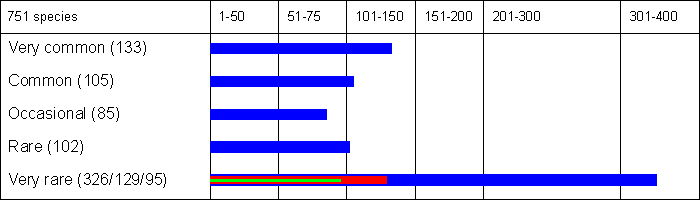 Localities: The number of localities where a species was found, with the percentage from all localities (with more than 20 indications). Since most species are limited (1) to a certain type of sediment and (2) to a certain area, the percentage value will be rarely above 50. Facies: The facies is a value that ranges from fine to coarse sediment. A silty mud has the value 5, a rocky shore without sediment except rocks larger than 5cm in diameter has the value 100. The facies given for each species is the average facies value of all localities where the species was found. Localities with a mixed environment (e.h. small sandy bays that are delimited by rocky capes) are not included in this analysis. A value close to 50 means that the species is adapted to various habitats whereas an extreme value (below 30, above 70) means, that the species prefers a certain habitat. So, species with an extreme low or high facies value are not found everywhere. Please compare also to the distribution page. Size: The maximum size was taken from Coan & Valentich-Scott (2012; bivalves) and Huber (2010, 2015; bivalves), Skoglund (2002; gastropods), and the very helpful former internet page www.gastropods.com (now at https://conchology.be/?t=261; gastropods).
|
|
Names Classification Literature Statistics Images Family list |
5. ImagesMost images show beach finds. There are a few exceptions, material I bought from fishermen or at souvenir shops. Specimens bought in shops mostly get there by fishermen. Typical species that are offered are Cypraea cervinetta, Hexaplex nigritus, Lobatus peruvianus, Melongena patula, Lobatus galeatus, and – a little bit rarer – Oliva porphyria. I observed some specimens at shell middens that are all around of the small villages. It is clear that the material comes from the same area but not from the beach. So there are some species I did not find myself (about 5%), and there are several of which I found only fragments myself.There is no scale, but the largest dimension is given in the figure caption. For the details how I took the images please compare to the page of imaging.
|
|
Names Classification Literature Statistics Images Family list |
6. Family listFamilies with new species (compared to the previous version) are marked with an asterisk (*).
|